Serial Interface
RockBLOCK Pro provides one physical serial interface and two USB Type-C virtual serial ports for local device control, configuration, firmware maintenance, positioning data and Iridium Messaging Transport (IMT) messaging.
Connect the physical serial interface
RockBLOCK Pro ANT and SMA
Use the 12-way Power, Serial and GPIO cable. See the installation pinout and wiring table.
RockBLOCK Pro OEM
The OEM product exposes the physical serial interface through its 30-way header. Refer to the RockBLOCK Pro OEM pinout and integration notes before designing or connecting an interface board. The Pro OEM pinout is different from the Mini OEM pinout.
Default settings
| Setting | Default |
|---|---|
| Interface mode | RS232 |
| Baud rate | 115200 |
| Data bits | 8 |
| Parity | None |
| Flow control | None |
The physical port can be changed to a supported RS4XX mode or another baud rate in user.cfg. See Serial Communication in the RockBLOCK Pro User Configuration guide.
Use the serial interface
- Use the shared AT command reference for device control, configuration, positioning and IMT messaging.
- Follow the firmware and configuration update process when transferring firmware or configuration files over the physical serial port.
- Configure GNSS or A-PNT NMEA forwarding in the User Configuration guide.
Browse all RockBLOCK Pro AT commands →
AT commands, serial firmware updates and NMEA forwarding share the physical serial interface. Use one function at a time. In particular, disable NMEA forwarding before using AT commands or starting a serial firmware update.
Virtual Serial Interface
Once the RockBLOCK Pro is connected via Type-C to an end device it will enumerate with two virtual ports.
On Windows the ports will show as any other COM* port, on Linux they will show as /dev/ttyACM* and on a MacOS they will show as /dev/tty.usbserial* or /dev/cu.usbmodem*
On Windows, com ports can be viewed in Device Manager or listed in Command Prompt (CMD) with mode
On Linux and MacOS, com ports can be listed in Terminal with ls /dev/tty*
The lower numbered VCP (Virtual Com Port) will use whichever AT interface is selected, and the RockBLOCK Pro will respond accordingly
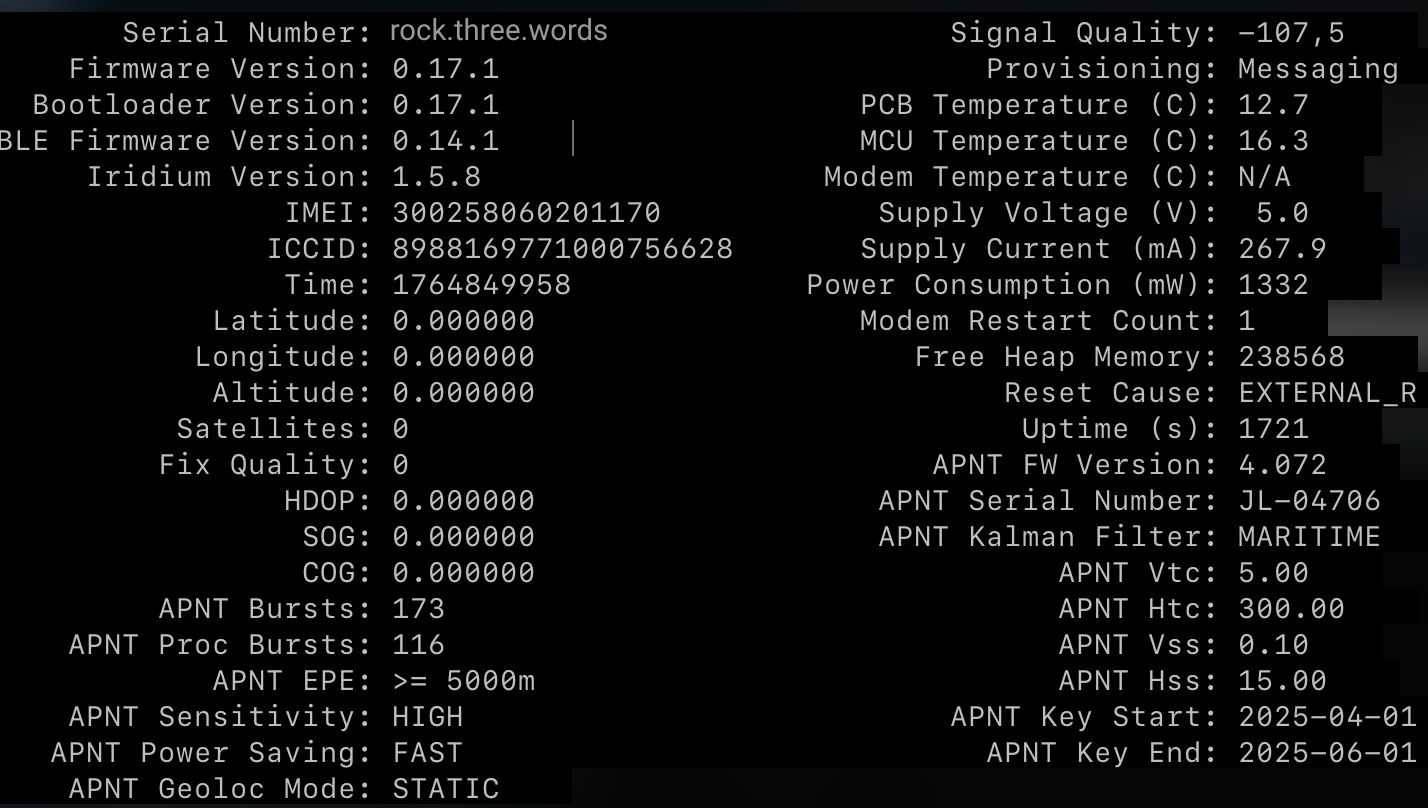
The higher numbered VCP will display a Statistics page with useful information as can be seen below